Category: Uncategorized

  • Crowdsourcing and Community Engagement

    Crowdsourcing and Community Engagement

    This piece was originally published in EDUCAUSE review vol. 50, no. 6 (November/December 2015)

    Read e-content | PDF


    In 2011, the New York Public Library (NYPL) released 9,000 digitized restaurant menus with “delicious data” that had been “frozen as pixels,” making the menus difficult to search, index, and discover online. Along with the menus, the NYPL launched an interface that asked the public to help transcribe the thousands of menus and the hundreds of thousands of dishes. In only three months, the menus (and dishes) were fully transcribed.

    The success of NYPL’s crowdsourced What’s on the Menu? demonstrates how enthusiastically public audiences respond to a well-defined project to which they can contribute through an expertly designed interface. While crowdsourcing has been used in the corporate world as a way to outsource tasks to nonemployees, it is increasingly being used in cultural and academic institutions for projects that seek to harness the energy and brainpower of the masses to complete specific tasks more quickly and inexpensively than would otherwise be possible. Many competing definitions of crowdsourcing exist, but perhaps one of the most helpful is offered by Enrique Estelles-Arolas and Fernando Gonzales-Ladron-de-Guevara: “A type of participative online activity in which an individual, an institution, a nonprofit organization, or company proposes to a group of individuals of varying knowledge, heterogeneity, and number, via a flexible open call, the voluntary undertaking of a task.”1

    In some instances, academic institutions have taken the lead in developing platforms that facilitate crowdsourcing. Zooniverse, owned and operated by a partnership of eight academic, nonprofit, and corporate institutions, currently hosts thirty-three projects that ask participants to carry out a wide range of tasks—from analyzing cancer cells to classifying galaxies to identifying the seasons in photographs of landscapes. The resulting input has led to ninety-four published articles to date.

    Crowdsourcing is particularly well suited to simple, repeatable tasks. The challenge often is to find ways for keeping participants engaged. Many classifications of crowdsourcing tasks have been proposed, but for academic and cultural institutions, the tasks may best be organized into four main categories:

    • Transcription
    • Supplementing Metadata
    • Collection Building & Curation
    • Identification & Provenance

    Transcription. Many crowdsourcing projects and games seek to address the gap that still-lagging optical character recognition (OCR) technologies leave in the quality of their digital transcription capabilities. Most OCR software, for instance, is unable to convert handwriting or languages that use a non–Roman alphabet into machine-readable text. Ancient Lives, part of Zooniverse, teaches users how to identify and then transcribe ancient Greek text that appears on Egyptian papyri. Even more projects use crowdsourced transcription to transform handwritten documents into readable and mineable texts. For example, DIY History, built at the Iowa Digital Library, uses a customized version of Omeka to crowdsource the transcription of several of its collections of letters, diaries, and manuscripts.

    Supplementing Metadata. Whereas text-based projects often require transcription, many cultural heritage institutions are increasingly facing the challenges of digitizing images and three-dimensional objects. These objects are virtually undiscoverable on the web without rich metadata. Recognizing this challenge, Dartmouth College’s Tiltfactor has partnered with several cultural institutions, including the British Library, to create a suite of competitive and collaborative games through which users provide metadata via a variety of tagging tasks. For instance, in Beanstalk, the user transcribes un-OCR-able words and fragments from digitized botanical texts. As the user provides transcriptions, the beanstalk grows higher and higher through various landscapes. Once the word has been transcribed multiple times in the same way by multiple users, the verified text is then returned to the library that holds the document and is added to its collection. As the game appeals to viewers: “Play Beanstalk, save scanned books from digital oblivion.”

    Collection Building & Curation. Beyond projects that seek to make existing texts digitally discoverable, crowdsourcing is also being used to build and curate collections online. Crowdsourcing has been especially useful in documenting and providing a space for public and private responses to community tragedies. Projects like the September 11 Digital Archive, the Hurricane Digital Memory Bank, and Our Marathon: The Boston Bombing Digital Archive engage with members of the public to collaboratively build sites of collective cultural memory. In crowdsourcing collection building and curation, cultural institutions retain the responsibilities for preserving and providing access to their collections while transferring the assemblage of the content of those collections to community members.

    Identification & Provenance. Crowdsourcing is frequently discussed in terms of the power of a massive and anonymous public. But crowdsourcing techniques are also being applied to smaller, more specialized audiences. For example, the Provenance Online Project, based at the Kislak Center for Special Collections, Rare Books, and Manuscripts at the University of Pennsylvania, relies on a community of experts outside of Pennsylvania to source and correct the provenance of individual books through the image-sharing platform Flickr.

    Crowdsourcing remains an important strategy for many emerging digital projects that seek to build community around and through their projects. The best-built crowdsourcing tools make clear what each participant adds to the project and why each participant matters to the project as a whole. Some tools take these strategies a step further, connecting participants to each other through forums, collaborative tasks, and competitive scoreboards.

    Perhaps the most-voiced concern about using crowdsourcing for scholarly projects is the quality of nonexperts’ contributions. To address this concern, the Maryland Institute for Technology in the Humanities is developing a transcription platform that clearly indicates the quality of available transcriptions from The Shelley-Godwin Archive. A red dot indicates an untranscribed document, yellow indicates a transcribed but unvetted document, and green indicates a vetted and approved transcription. As scholars increasingly build and contribute to crowdsourcing software, these technologies will become more reflective of the scholarly practices and concerns we share.

    Crowdsourcing, particularly as it is deployed in the private sector, may also become exploitative when unpaid or underpaid labor replaces paid work. On the one hand, crowdsourcing is completely voluntary, at the discretion of the participant. On the other hand, relying on unpaid labor could work to dehumanize participants.2 True, many cultural heritage institutions, which are chronically underfunded in the United States, have a long history of engaging volunteer labor. The argument for such labor is often framed in terms of the “greater good” and engages participants’ desires to contribute to an institution whose mission they support.3

    Crowdsourcing can open up access to previously inaccessible materials—but often in fragmented ways. Participants see snippets of text or a single letter, image, or document outside of the context of a collection. This fragmentation is frequently a result of trying to balance the need to lower barriers for participation with the overall goals of the project. Project designers often ask themselves questions such as the following: How much contextual information does the participant need to contribute meaningfully to the project? How do the goals of the project relate to the crowdsourcing efforts? How does the technology facilitate or hinder participation? If the crowdsourcing initiative is meant to increase buy-in of the project as a whole (as opposed to simply completing mundane tasks), more contextual information and cross-participant engagement are necessary.

    Only in the last few years have advances in technology enabled the large-scale, asynchronous collaboration that can produce a project like the New York Public Library’s What’s on the Menu? And yet the spirit behind such a project reaches back much further. As Mia Ridge reminds us: “Technology has enabled crowdsourcing as we know it, but models for public participation in collection, research and observation pre-date it.”4 As crowdsourcing gains purchase in academic and cultural heritage sectors, new crowdsourcing tools and platforms will be transformed by scholars, artists, librarians, and curators who seek to engage with community members in meaningful ways. And these new platforms and modes of engagement will, in turn, transform the very shape of the scholarship and creative works that seek to engage communities.

    Notes

    1. Enrique Estelles-Arolas and Fernando Gonzalez-Ladron-de-Guevara, “Towards an Integrated Crowdsourcing Definition,” Journal of Information Science 38, no. 2 (April 2012), 197.
    2. Aniket Kittur, Jeffrey V. Nickerson, Michael Bernstein, Elizabeth Gerber, Aaron Shaw, John Zimmerman, Matt Lease, and John Horton, “The Future of Crowd Work,” in Proceedings of the 2013 Conference on Computer Supported Cooperative Work (New York: ACM, 2013).
    3. Mia Ridge, ed., Crowdsourcing Our Digital Heritage (Farnham, UK: Ashgate, 2014), 5.
    4. Ibid. The Oxford English Dictionary‘s 1857 appeal to the public for “unregistered” words is one of the most notable examples. See Peter Gilliver, “‘Your Dictionary Needs You’: A Brief History of the OED’s Appeals to the Public,” Oxford English Dictionary, October 4, 2012.


  • The Challenges of Preservation in the Prospects for the Digital Humanities and the Arts

    The Challenges of Preservation in the Prospects for the Digital Humanities and the Arts

    This post was originally published as part of the Council on Library and Information Resource’s (CLIR) blog Re:Thinking. 

    ⌘+ S. We save almost without thinking about it. With the widespread adoption of word processing software, we’ve become thoroughly conditioned to save as we create. Not so with digital projects. There’s no easy equivalent to the ubiquitous “⌘ + S” that would automagically provide long-term preservation of digital objects and projects. As such, the urgent problems of preservation continue to require thoughtful conversations and deep planning.

    On April 10 & 11th, scholars, librarians, archivists, and artists from 11 institutions spread across the northeast gathered at The Sterling and Francine Clark Art Institute in Williamstown, Massachusetts to weigh in on “Prospects for the Digital Humanities and the Arts.”

    During the CLIR-sponsored colloquium, participants considered a wide range of challenges and opportunities facing higher education and cultural institutions committed to supporting digital research, scholarship, and pedagogy. The presentations and discussions collectively explored the life cycles of digital work—from the initial creation of digital objects, to the research and discovery process, to the production of scholarship, to the dissemination of that scholarship (both through publication and through pedagogy), to the preservation of that research.

    While each of these stages is deserving of more than a single blog post, my notes from the colloquium return again and again to the challenges of preservation. The questions raised and explored by the group will sound familiar to many of us working in and with digital scholarship: What should be preserved? Where should it live? When should it be preserved? For how long? For whom? By whom? And in what form? Behind these questions lies an implicit belief in the intrinsic value of objects and in the ability of preservation processes to maintain an acceptable portion of that value.

    Any deep discussion of preservation must also confront the anxiety about loss that often motivates and shapes preservation programs. Many of the projects and curricular activities showcased in the colloquium engaged both with fragile materials objects (including textiles, rare books, and film reels) and with digitized versions of those objects. Through discussion it became clear that we sometimes focus our attention on the fragility of material objects and forget that digital objects are also material and fragile, often prone to loss at a far higher rate than, for instance, paper, which has proved remarkably resilient. And it isn’t just the objects of our research that are deteriorating and becoming inaccessible, as Gerald Zahavi (University of Albany) reminded us, but also the hardware through which we once experienced those objects.

    While conversations about preservation can be overwhelmed by a sense of loss, there was also a clear consensus in the group that some things must be protected from preservation. Many classroom activities and art objects are created to be ephemeral. To escape or even resist preservation. There’s a lot of room here, I think, for further dialogue and for thinking strategically about the dangers as well as necessities of preservation. (The history of the controversial practice of preserving natural habitats, for instance, might provide some provocative parallels and lessons.)

    So who is responsible for preservation? Faculty members? Librarians? Archivists? All of the above? While the practice of digital scholarship can introduce students and scholars to preservation issues, the immediate challenges of creating new digital work can deflect attention away from preservation. And existing institutional structures and pressures can make planning for preservation incredibly difficult. While the pressures to produce digital scholarship increase, the timelines for production (especially the promotion and tenure processes) have not yet adjusted—or, as in the case of graduate education, have actually been shortened. With few exceptions, it takes more time to produce digital scholarship and digital projects than our institutions are accustomed to support. It takes more collaboration. It takes more expertise. All of these challenges often push preservation off the proverbial table.

    And this is where I think libraries can and do play a critical role in facilitating the production and preservation of new digital scholarship. Libraries are increasingly housing centers for teaching and research, digital humanities programs, special collections and archives, and open access presses—as we heard from numerous participants at the colloquium. In many ways, libraries are at the center of the preservation challenge. So, what do libraries need in order to meet this challenge?

  • Building Digital Exhibits in the Classroom with Omeka and Neatline

    Building Digital Exhibits in the Classroom with Omeka and Neatline

    How can the digital humanities facilitate more direct engagement between academic researchers, students, and public audiences? At Our Marathon: The Boston Bombing Digital Archive, where I am currently Co-Director, we decided very early on that active public participation was integral to the success of the project. In addition to public engagement, we also wanted to create a digital archive that included robust metadata (or information about each of our objects) that would aid future researchers who wanted to work with our collections. It didn’t take long for us to settle on using Omeka.

    Omeka is an open-source content management system (CMS) built at the Center for History and New Media at George Mason University that enables users to collect, annotate, and exhibit digital objects and artifacts. Omeka is a really powerful and useful tool for any digital humanist. Because Omeka is open-source, many digital humanities programs have developed features that you can add on (or “plug-in”) to Omeka to extend its uses. One of the most exciting plug-ins developed for Omeka is Neatline, a tool that helps students, researchers, and archivists create dynamic and rich digital exhibits. With the addition of two small apps, called SIMILE Timeline and Waypoints, Neatline can be used to set up multi-faceted digital exhibits that users can explore through time, space, or narrative. You can read more about Neatline here.

    Photo of Neatline exhibit with historical map of Middlebury Vermont
    An example of a Neatline exhibit that uses the Simile widget.

    Examples of Student-built Exhibits:


    Examples of Researcher-built Exhibits:

    More Neatline Tutorials


  • 6 Things to Consider when Building a Dataset from Scratch

    6 Things to Consider when Building a Dataset from Scratch

    This post is about my experiences at the Digital Humanities Summer Institute (DHSI) held at the University of Victoria, June 5-10 2013.  

    Last month I attended my first DHSI on UVic’s idyllic campus. In just five days I became proficient in the notoriously difficult ArcGIS; moved my research several, big steps forward; and met some wonderful folks working on amazing projects.

    The course I was enrolled in, “Geographical Information Systems (GIS) in the Digital Humanities,” asked attendees to bring their own data. Being a DH newbie, I had no idea what kind of data was out there or how to find it. I exchanged a few emails and then met with my university’s newly hired GIS expert about where to find data on my topic. She had some excellent recommendations for providing historical context data (UK Met Office for weather, Botanical Society of the British Isles for botany, and Natural England for wildlife populations, to name a few). But when I described my project in detail she looked at me and said, “Well, it sounds like we’re going to need to build your dataset from scratch.” I spent the next month trying to figure out what exactly a dataset really was and how to build one for my research on Edith Holden’s naturalist field books.

    Here’s what I learned in the process:

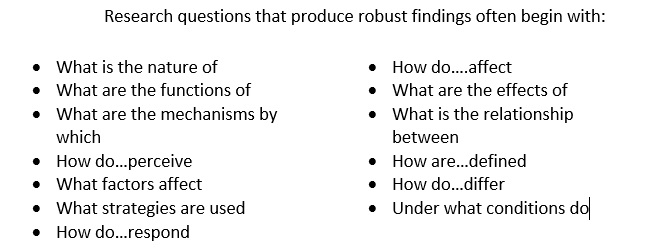
    1. Shape your research questions first. They may change, in fact they’re almost certain to change once you begin your research. But having a robust research question or set of questions before you begin will help temper the feelings of bewilderment often produced by beginning a dataset from scratch. I find Sonja Foss and William Waters’s list in Destination Dissertation (pg. 41) particularly useful in forming research questions – and so have my students. Image
    2. Start simple. When I opened my excel spreadsheet and began creating columns for all the pieces of data I thought I wanted, I ended up with fifteen columns and a near-infinite, horizontal-scrolling problem. It was also taking me far too long to complete the dataset. So I simplified by narrowing my fields down to five, manageable columns: source, date, lat/long, type, and label. As you can see they are relatively basic kinds of information that are easily generalizable to other texts and projects.
    3. Move beyond your doubts. Cutting back the number of columns was terrifying. What if I missed something important? What if my data wasn’t robust enough? What if it didn’t show me anything new? Would digital humanists scoff at my work? But then I realized that those questions, with a few substitutes, were pretty much the same doubts that I experienced when putting together my dissertation prospectus. They’re the same doubts that plague most graduate students and likely many early-career academics as well. Some of these questions are twisted versions of legitimate concerns academics should ask themselves about their research, but they are rarely useful and almost always harmful in the initial stages of a project. Shelve them for now and return to them (in their un-twisted forms) when you have a better sense of your project.
    4. Failure can be fruitful. Perhaps even more fruitful in this kind of digital work than in “traditional” research. If your data doesn’t show you something you expect, it will likely show you something unexpected. In other words, the potential for new insights is even greater when working through failures – whether they be failures in the data design, in the data mining, or in the data presentation.
    5. Don’t be afraid to ask for help. At whatever stages of the research you need it. I may have been stuck worrying that my data design wasn’t elaborate enough to constitute important research if I hadn’t asked a DH faculty member at my university what a dataset actually looked like. He shared a dataset with me, from a project he had completed, that was reassuringly elegant in its simplicity. It was an excel spreadsheet, with six columns of basic data (e.g. year of publication, place of publication, type of publication) that became a very useful model for my own project.
    6. Savor the rewards. Maybe it’s the type-A in me coming out of the closet after years of unstructured academic research, but the gratification of seeing a spreadsheet full of beautiful data that I had collected felt even better than the satisfaction I experience after filling a page with writing. It’s even more rewarding when that data becomes something – whether that be evidence for your argument, items in a digital archive, or, in my case, a multi-layered map of Edith Holden’s field books.

    Of course you don’t always have to build a dataset from scratch. There’s more data out there than you probably expect. Start with government agencies and societies organized around your topic or data need (e.g. The Royal Astronomical Society). In a larger project or with the right resources, you may be able to work with a developer or Computer Science experts to build an algorithm to collect digital data for you.

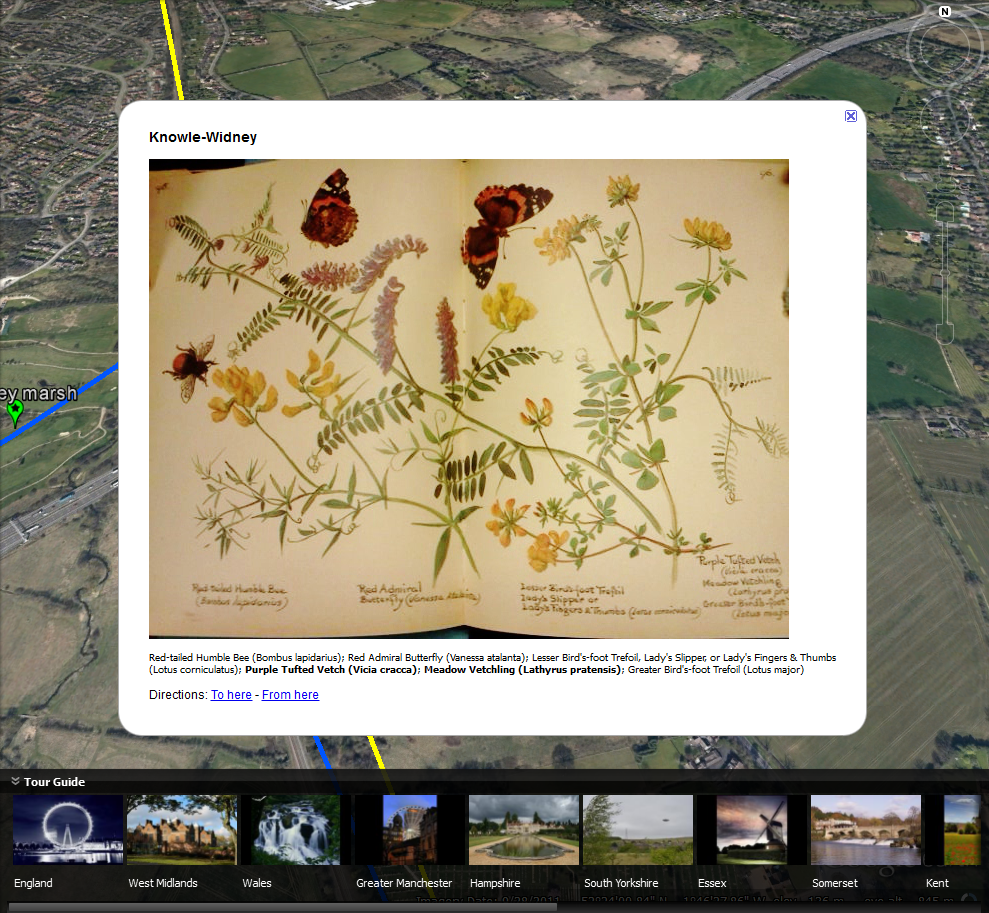
    But for most of us, building a dataset often comes down to manually inputting columns and columns of data, gleaned from digitized or undigitized texts, into spreadsheets. While the work is often monotonous, the results can be invigorating. Here’s a static snapshot of the dynamic map my dataset has helped me create and a little foretaste of a future post:

    Screenshot of a google earth map with a pop-out photo of the inside of a book.

  • Towards an Otherwhere

    Towards an Otherwhere

    Last night, at Duke’s Feminist Theory Workshop, Elizabeth Povinelli presented some of her recent work around geontologies. Both in the talk and in the q & a afterwards, there were often turns to her concept of “living otherwise”—that is, living in non-normative ways.  The phrase calls up for me early twentieth century writer Vita Sackville-West’s long poem The Land (1927) in which she describes the usefulness or even necessity for “reaching out towards an otherwhere.” Here’s the line with some context:

     And women still have memories of woods,

    Older than any personal memories;

    Writhen, primeval roots, though heads be fair,

    Like trees that fan the air with delicacies,

    With leaves and birds among the upper air,

    High, lifted canopies,

    Green and black fingers of the trees, dividing

    And reaching out towards an otherwhere,

    Threaded with birds and birds’ sweet sudden gliding.

    It is one of the most hauntingly beautiful passages of the poem. For “women,” Sackville-West seems to say, the “here” is not safe, not available, not fully inhabitable. Instead, the trees—which Sackville-West later associates with women through the figure of the dryad—search for an alternative place to inhabit. Not necessarily a safer place, but an “otherwhere” nonetheless.

    In Povinelli’s figuration of “living otherwise,” the attention is placed on practice, that is, the act of living or even the manner of living. In Sackville-West’s figuration, the attention is directed toward place. This idea of an “otherwhere” is incredibly provocative. What does it mean to reach toward a space which is not here? A place whose very existence as “other” depends on the existence and inhabitation of a “here” which might be conceptualized as a “normative” space? In many ways, this has been the work of many marginalized peoples, communities, and disciplines—to claim that which is “other-ed” (in ability studies and queer theory, for example) and in some cases to bring the “other” (-place, -people, -practice, etc.) into mainstream discourses and practices, with sometimes dubious results (e.g. gay marriage in the U.S.).

    What might be the meaningful differences between and emphasis on place versus an emphasis on practice? Perhaps the most obvious response to such a question is that they need not be mutually exclusive. It has been theorized that places are created by practice. And practices occur in both time and space. But I’m interested to hear what you think. Have we left theorizations of “space and place” behind us in the move to theories of practice? With what gains and what consequences?

  • “Learning from Nature”

    “Learning from Nature”

    I attended a recent MLA roundtable on Sustainability and Pedagogy that had me thinking (again) about the relationship between the environmental/ecocritical content some of us teach and the ways in which we teach that content. As eco-conscious teachers, it’s often difficult to help students find a place between the paralysis caused by feelings of helplessness about environmental degradation and the glorification of “Nature” as something pure and, therefore, worthy of preservation. My larger research project is interested in texts that exist in those in-betweens, particularly in the first half of the twentieth century.

    This post is about a mixed-genre text, created by Edith Holden to chronicle, month by month, the activity she observed in the landscapes around Olton, Warwickshire. The collection, titled Nature Notes, 1906, weaves together folklore, poetry, journal entries, watercolors, botanic information, field notes, and more.

    IMG_20130117_133356 (2)

    The book was never meant for publication, but in 1977 it was printed in facsimile under the new title The Country Diary of an Edwardian Lady. The change in title forebode its reception in the late twentieth century: it became a best seller, inspired a popular biography (by Ina Taylor, 1980), and spawned a 12-part TV miniseries. Reviews and spin-offs of Nature Notes have tended to focus on the text’s “nostalgic charm,” yet Holden’s text was intended, not as an ornamental coffee table book, but as a practical model for her students at Solihull School for Girls where she taught art from 1906-1909.

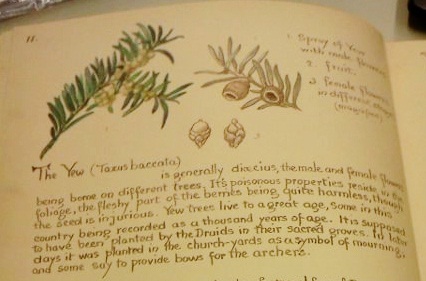
    To a great extent, the teaching that occurs in this text is implicit, subtle, even circuitous. It is teaching by example or model, not by explicit instructions. “This is how you might go about it,” the text seems to offer.

    Yew Cropped

    The practice of learning from nature has a long history that continues into the twenty-first century (see biomimetics). Gardens, especially, have been used to teach children and young women how to become well-behaved members of society since at least the eighteenth century. Holden’s field books continue this tradition by expanding the didactic space of the garden to the “wild” spaces of uncultivated landscapes. As a result, these “wild” spaces no longer seem dangerous, threatening, or uncontrollable, but instead become associated with domestic(ating) practices like drawing and flower arrangement. It seems no accident that the pages of Holden’s text are populated with images of flowers, birds, and butterflies with only the occasional reptile, amphibian, or stinging insect.