I attended a recent MLA roundtable on Sustainability and Pedagogy that had me thinking (again) about the relationship between the environmental/ecocritical content some of us teach and the ways in which we teach that content. As eco-conscious teachers, it’s often difficult to help students find a place between the paralysis caused by feelings of helplessness about environmental degradation and the glorification of “Nature” as something pure and, therefore, worthy of preservation. My larger research project is interested in texts that exist in those in-betweens, particularly in the first half of the twentieth century.
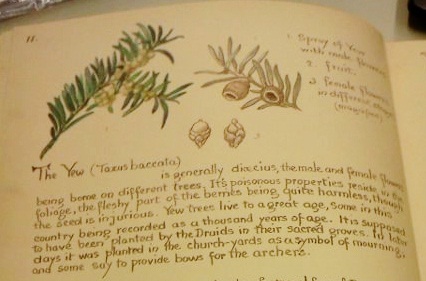
This post is about a mixed-genre text, created by Edith Holden to chronicle, month by month, the activity she observed in the landscapes around Olton, Warwickshire. The collection, titled Nature Notes, 1906, weaves together folklore, poetry, journal entries, watercolors, botanic information, field notes, and more.

The book was never meant for publication, but in 1977 it was printed in facsimile under the new title The Country Diary of an Edwardian Lady. The change in title forebode its reception in the late twentieth century: it became a best seller, inspired a popular biography (by Ina Taylor, 1980), and spawned a 12-part TV miniseries. Reviews and spin-offs of Nature Notes have tended to focus on the text’s “nostalgic charm,” yet Holden’s text was intended, not as an ornamental coffee table book, but as a practical model for her students at Solihull School for Girls where she taught art from 1906-1909.
To a great extent, the teaching that occurs in this text is implicit, subtle, even circuitous. It is teaching by example or model, not by explicit instructions. “This is how you might go about it,” the text seems to offer.
The practice of learning from nature has a long history that continues into the twenty-first century (see biomimetics). Gardens, especially, have been used to teach children and young women how to become well-behaved members of society since at least the eighteenth century. Holden’s field books continue this tradition by expanding the didactic space of the garden to the “wild” spaces of uncultivated landscapes. As a result, these “wild” spaces no longer seem dangerous, threatening, or uncontrollable, but instead become associated with domestic(ating) practices like drawing and flower arrangement. It seems no accident that the pages of Holden’s text are populated with images of flowers, birds, and butterflies with only the occasional reptile, amphibian, or stinging insect.